Break the Fight Cycle: The Psychology of Recurring Fights
Ever notice your fights feel like reruns? Different episode title, same plot, same ending, and somehow nobody ever renews the show for a happier season.
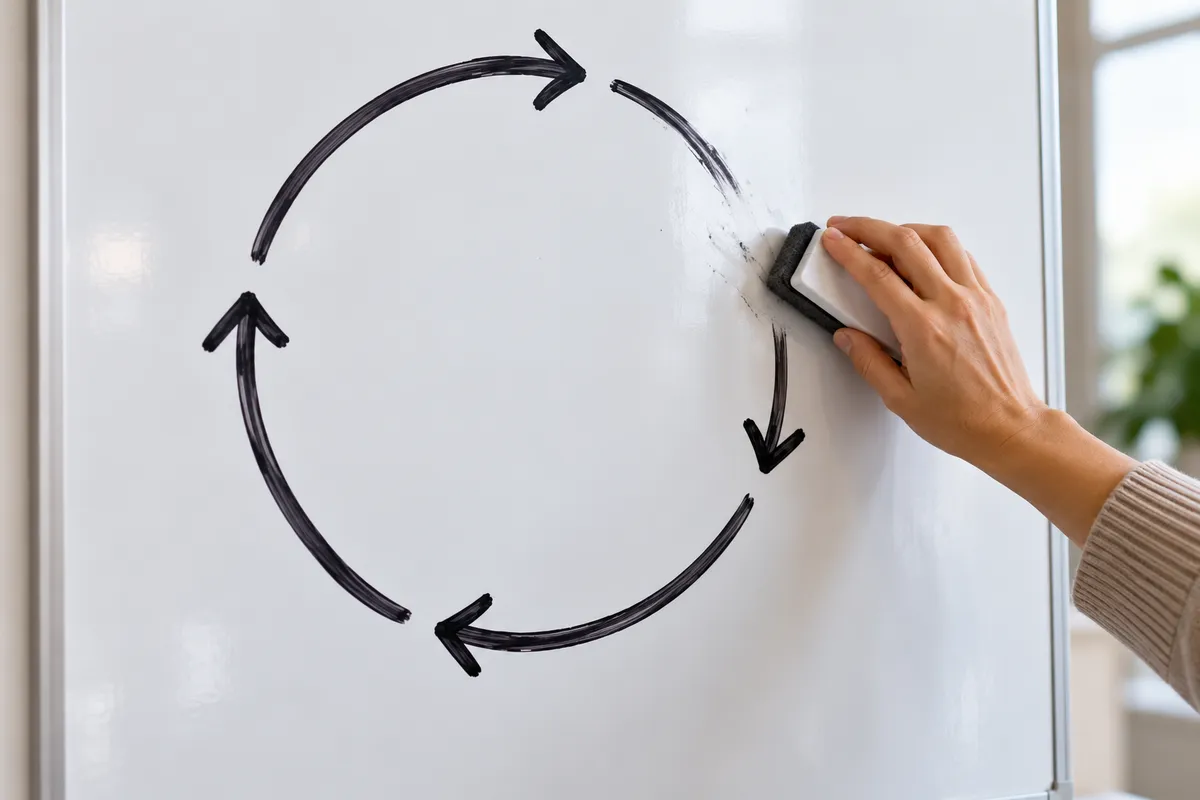
That rerun is a fight cycle: the part of an argument that stays the same even when the subject changes. One week it’s money. The next it’s dishes, a late text, weekend plans, or a comment delivered in exactly the wrong tone.
The topic changes. The sequence doesn’t. One person raises a concern, the other gets defensive, the first pushes harder, and the second goes quiet, leaves, explains, counterattacks, or says “fine” in a tone that clearly means the opposite. Both people end up feeling misunderstood.
The Psychology of a Fight Cycle
One of the most studied recurring patterns is demand-withdraw: one partner presses for discussion or change while the other avoids or pulls back (Christensen & Heavey, 1990). The pattern makes sense from both sides. The pursuing partner feels that pressing on shows they care. The withdrawing partner feels that stepping away is the only way to keep things from getting worse.
Research has found this pattern more common, and more rigid, among distressed couples (Eldridge et al., 2007). Which partner does the pushing often depends on whose issue is being discussed, and the pattern left people less satisfied with how conversations ended, even though it didn’t on its own decide whether a conflict got resolved (McGinn et al., 2009).
The cycle also includes the aftermath. People whose partners recovered well after a conflict reported more positive relationship feelings and greater satisfaction (Salvatore et al., 2011). When recovery is slow, the next disagreement starts with less goodwill.
4 Fight Cycle Examples
See if you recognize anyone. No judgment if you recognize yourself in more than one.
Pursue and withdraw
Maya wants to talk about a problem right away, because leaving it unresolved makes her anxious. Chris needs time to calm down, so he goes quiet and eventually leaves the room. Maya follows because his silence feels like rejection. Chris feels more pressure and pulls away further. Neither is trying to hurt the other; their moves simply fit together in a way that raises the pressure.
Attack and defend
Jordan points out a mistake. Sam hears criticism and fires back: “Well, you do the same thing.” Jordan brings up another example, and Sam finds another defense. Soon neither is talking about the original problem. They’re both building cases.
Explain and shut down
Lee feels misunderstood and explains the point again, then again, louder and with more detail. Pat feels lectured and stops responding. Lee reads the silence as not caring and explains even harder.
Smooth over and resent
Robin hates conflict. As soon as tension rises, Robin says, “It’s fine. Forget it.” The argument stops while the issue stays unresolved. Over time Robin grows resentful, and their partner assumes everything is fine because Robin keeps saying so.
How to Break the Fight Cycle
1. Map the sequence after the argument
Start with the order of events instead of who was right.
• What was the original issue?
• What was the first sign the conversation shifted?
• What did I do next, and what did my partner do next?
• How did it end, and what happened afterward?
2. Identify your automatic move
Most people have a reliable response under pressure: pushing, defending, explaining, going silent, leaving, apologizing too fast, or smoothing things over. These moves usually developed for good reasons. Once you notice yours, you can start to change it.
3. Agree on an early signal
Pick a simple phrase either of you can use, such as “I think we’re in the loop” or “We’ve left the original issue.” It’s a shared reminder that the pattern is taking over, never a way to win the point.
4. Choose one different next move
You don’t need to be perfect in the next argument. Choose one alternative: ask a clarifying question, take a pause with a return time, reflect what you heard, lower your voice, or stop explaining after the second try. A different move gives your partner something different to respond to.
Why the Cycle Is the Problem, Not the Person
When a couple can say “We keep getting stuck here,” the conversation changes. The focus shifts from “You always do this” to “What happens between us when I feel ignored and you feel pressured?” That keeps accountability intact while giving both people something practical to work on.
Safety note: If you feel afraid of your partner, or the relationship includes threats, control, monitoring, or violence, general relationship advice isn’t the right starting point. Call the National Domestic Violence Hotline at 1-800-799-7233 or text START to 88788. |
How Break the Fight Cycle™ Can Help You
This is the kind of recurring conflict pattern Break the Fight Cycle™ was built to address. The program helps you map the sequence, spot your own automatic move, and practice a different response before the argument follows its familiar path again. Break the Fight Cycle™ is a private, self-paced online program. In the Starter Series (Modules 1–3), you’ll learn to: ✓ Map how a real argument escalated, from the first spark to the aftermath, using The Escalation Circuit™. ✓ Recognize your own escalation style among seven common patterns (The 7 Escalation Styles™), without labeling or diagnosing anyone. ✓ Practice C.A.L.M.™ and choose a deliberate response to replace your automatic reaction. No workshops, no group sessions, and no explaining your relationship to strangers. Start Breaking the Fight Cycle → www.relationshiplovetips.com/btfc-launch Practical relationship education for recurring conflict patterns. Not therapy, crisis care, or a substitute for professional support. |
Follow us: TikTok | YouTube | Instagram | Facebook
Frequently Asked Questions
What is a fight cycle in a relationship?
A fight cycle is a repeating sequence of reactions that shows up across different arguments. The topic changes while the interaction stays familiar.
What is the psychology behind recurring fights?
Research on the demand-withdraw pattern shows how one partner’s pursuit and the other’s withdrawal can intensify each other. Other cycles include attack and defend, explain and shut down, and smoothing things over followed by resentment.
How do you break a fight cycle?
Map the sequence after an argument, identify your own automatic response, agree on an early signal, and practice one different next move.
References
Christensen, A., & Heavey, C. L. (1990). Gender and social structure in the demand/withdraw pattern of marital conflict. Journal of Personality and Social Psychology, 59(1), 73–81. https://doi.org/10.1037/0022-3514.59.1.73
Eldridge, K. A., Sevier, M., Jones, J., Atkins, D. C., & Christensen, A. (2007). Demand-withdraw communication in severely distressed, moderately distressed, and nondistressed couples: Rigidity and polarity during relationship and personal problem discussions. Journal of Family Psychology, 21(2), 218–226. https://doi.org/10.1037/0893-3200.21.2.218
McGinn, M. M., McFarland, P. T., & Christensen, A. (2009). Antecedents and consequences of demand/withdraw. Journal of Family Psychology, 23(5), 749–757. https://doi.org/10.1037/a0016185
Salvatore, J. E., Kuo, S. I.-C., Steele, R. D., Simpson, J. A., & Collins, W. A. (2011). Recovering from conflict in romantic relationships: A developmental perspective. Psychological Science, 22(3), 376–383. https://doi.org/10.1177/0956797610397055
Related Articles
• How to Fight Fair in a Relationship: 10 Rules for Healthy Arguments
• Why Do We Keep Having the Same Fight? How to Break the Cycle
• Why Small Arguments Become Big Fights (and How to Stop the Spiral)
• Why Does My Partner Shut Down During Arguments?
• Start the Break the Fight Cycle™ Starter Series


